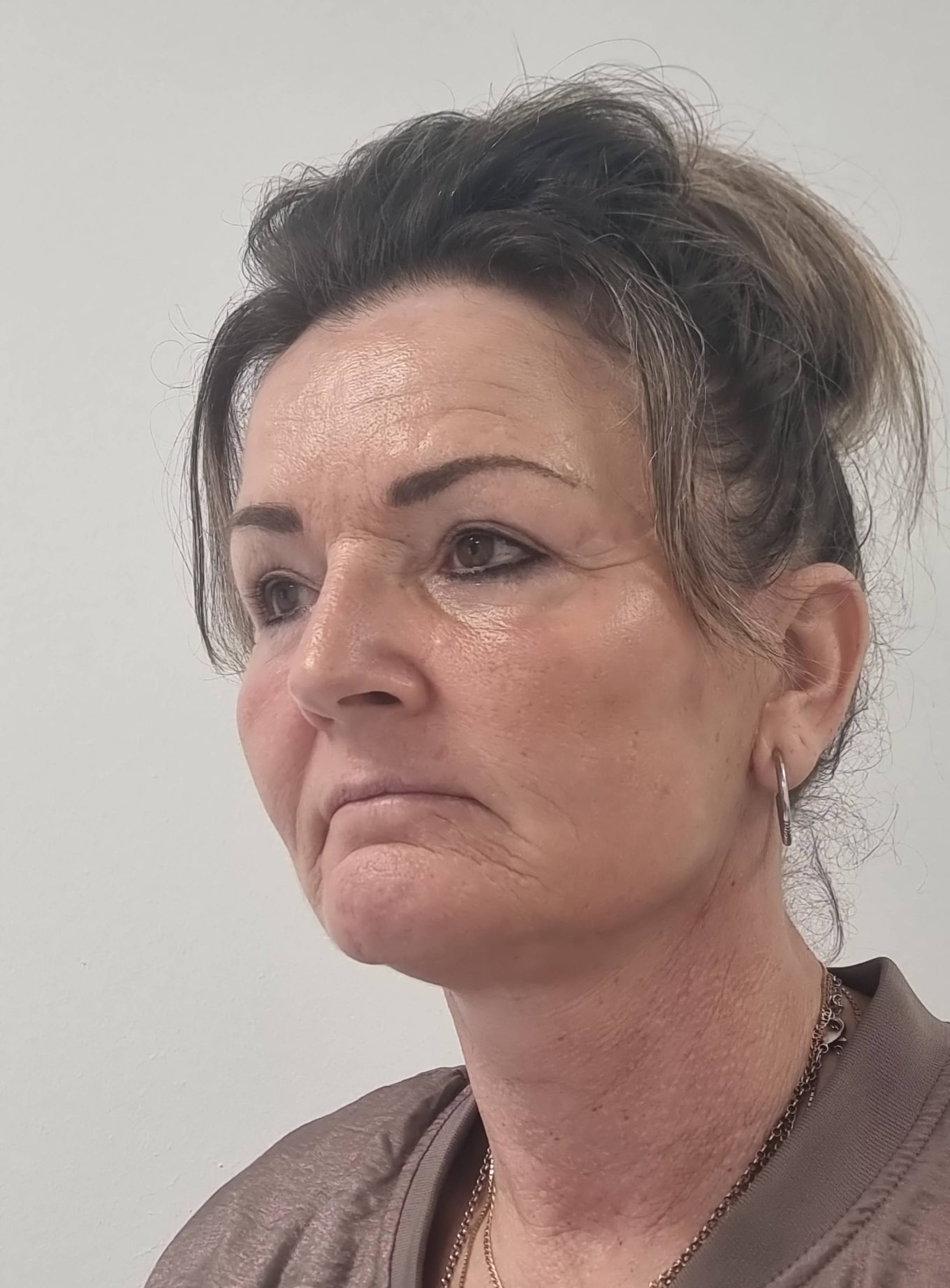
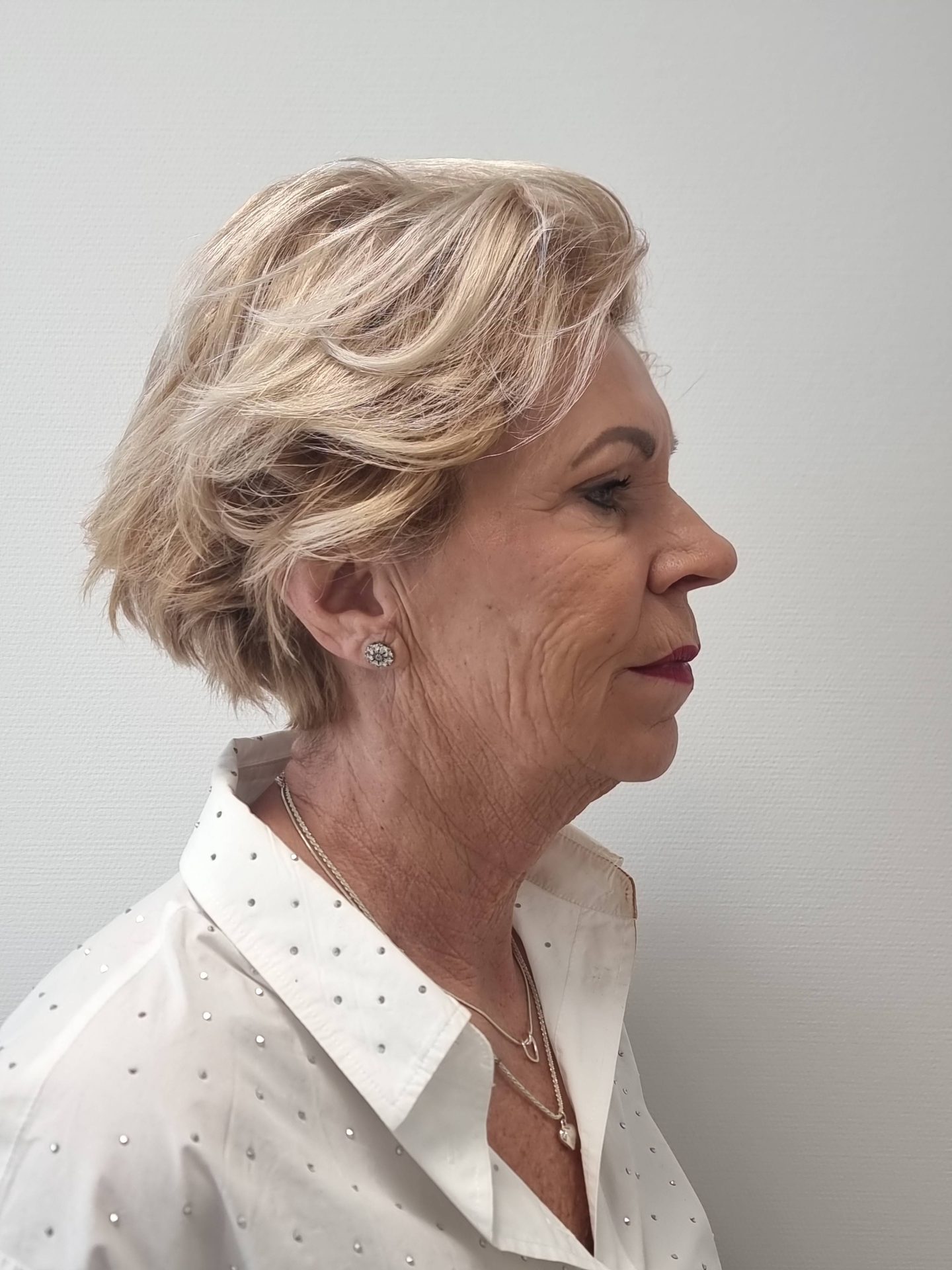
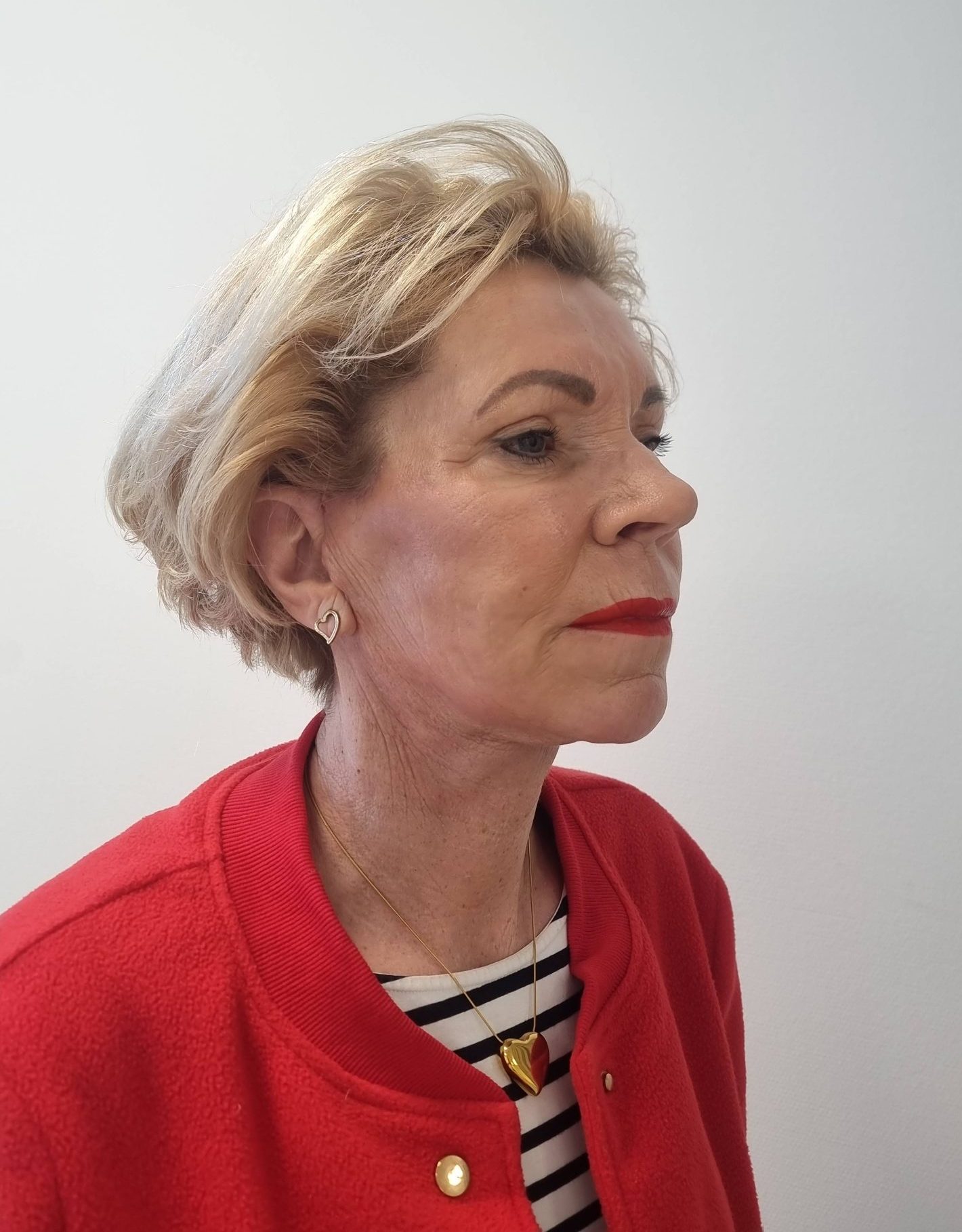
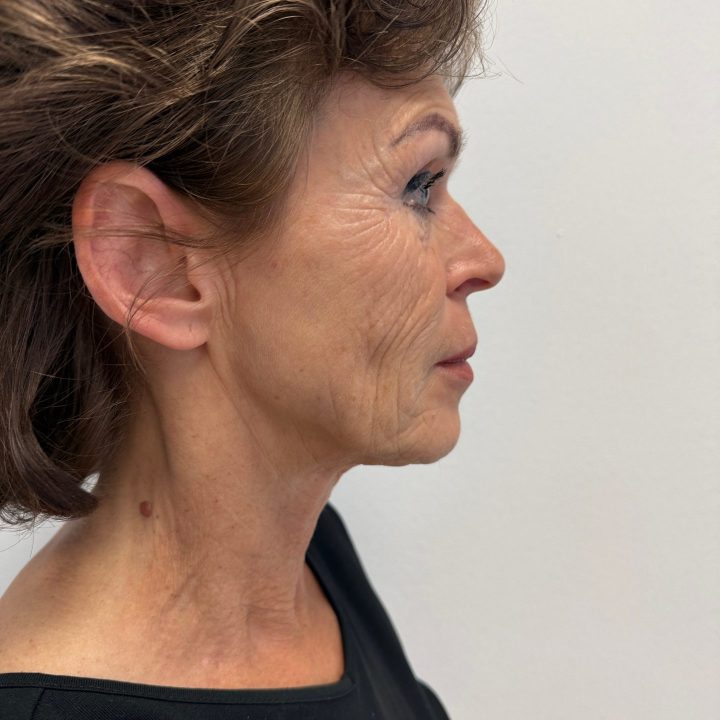
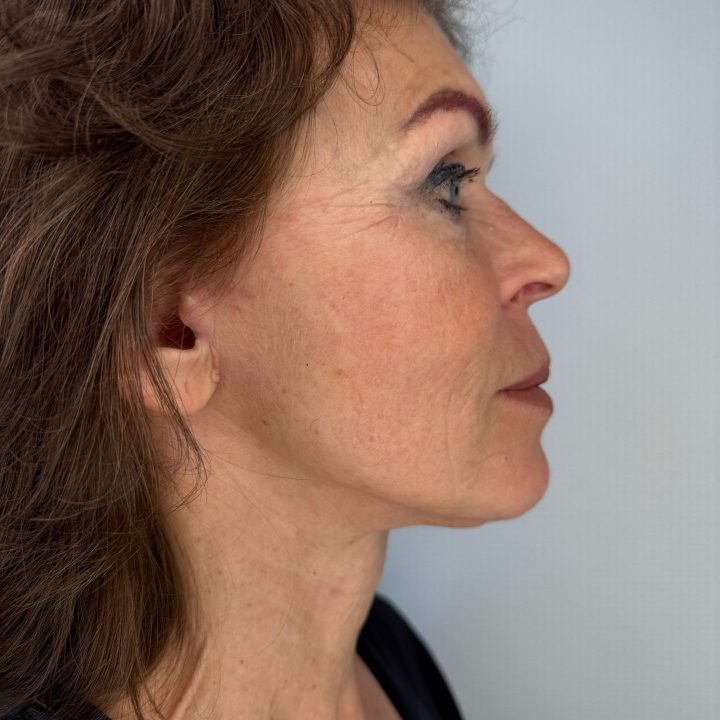
There is a lot of confusion surrounding the terms used for a facelift. Below you will find an explanation of the three facelift variants that are possible and what you can expect from them.
S-lift
The least invasive facelift is the S-lift (sometimes also called a mini facelift or mini lift). A small S-shaped incision is made in the skin, running in front of the ear. After a limited area of the skin has been detached from the underlying tissue, the skin is pulled towards the ear so that the jawline regains its original contour. A strip of skin in the shape of an S is removed, after which the skin is stitched. An S-lift only produces results for the area just above the jawline. An S-lift can be used to correct so-called jowls. The contour of the jawline becomes tighter, but wrinkles around the mouth, the lips and the eyes do not disappear after an S-lift. With the S-lift, only the superficial skin tissue is lifted, not the underlying muscle tissue. An S-lift is performed as a day case and can take place under local anaesthetic. If you prefer, you can also opt for an S-lift under general anaesthesia. As a rule, you can go home the same day after the treatment.
Facelift MACS lift
Unlike the superficial skin correction of the S-lift, a MACS lift tightens not only the facial skin but also the deeper tissue layers. This so-called SMAS tissue (SMAS: Superficial Muscular Aponeurotic System) is heavier than the skin itself and can cause the upper tissue layers (skin and fatty tissue) to sag. In a MACS lift, the plastic surgeon makes an incision from the temple in the hairline downwards, running in front of the outer ear. After the skin and muscle tissue have been detached from the underlying tissue layer, the facial muscles on both sides are first tightened in the direction of the ear and the temple. The plastic surgeon stitches this muscle tissue in such a way that it returns to its original position. This is also known as plication. The muscles in the face are shortened by folding them double and stitching them in place. The overlying skin is tightened in the same direction. Excess skin tissue is removed and the skin is closed again with stitches at the site of the incision. Because a MACS lift also lifts the deeper tissue layers, it is a much longer-lasting solution than an S-lift. A facelift can remove deep folds around the mouth and so-called jowls. A MACS lift always takes place as a day case. This means that, as a rule, you can go home the same day.
Face/neck lift
The combined face and neck lift is the most extensive facelift and also gives the most comprehensive results. As with a MACS lift, the plastic surgeon makes an incision from the temples downwards, running in front of the ear. The incision runs under the earlobe, back upwards, and ends at the hairline behind the ear. This makes it possible to tighten the tissue of the neck as well. As a result, a face and neck lift produces results both in the face and in the area below the jawline. A face and neck lift delivers the most comprehensive results. Deep folds in the face and in the neck can disappear with a combined neck and facelift. An eyelid correction can also be performed in addition to a face and neck lift. A face and neck lift always takes place under general anaesthesia and always includes an overnight stay. In most cases, you can go home again the following morning.
Neck lift
For excess sagging skin on the neck below the chin, a so-called turkey neck, a neck lift (also known as a Z-plasty) is a good solution. By making a small incision (in the shape of a Z) just below the chin, the skin can be tightened. This treatment only produces results for the neck and leaves a visible scar. People who suffer from sagging skin under the chin (the so-called turkey neck) choose this treatment. Only in a few cases does a neck lift give the desired result. Usually the neck involves not only slack skin but also slack neck muscles. In that case, it is advisable to undergo a combined neck and facelift. In this procedure, the skin and the underlying muscle tissue are tightened from behind the ear, giving results for the whole neck. A neck lift (Z-plasty) can be performed under local anaesthetic and the procedure takes place as a day case. This means that, as a rule, you can go home the same day. Combined neck and facelift
Forehead lift
A facelift cannot remove wrinkles on the forehead. A forehead lift is a solution for that. Both a facelift and an (endoscopic) forehead lift can also be performed in combination.